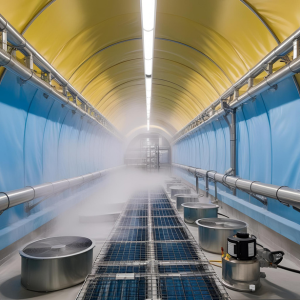
Industrial Mist Cooling Solution for Paperboard Plant

Truemist delivers advanced mist cooling solutions engineered specifically for corrugated box production environments, where temperature and humidity control is crucial for maintaining quality and efficiency. Our high-pressure misting systems help stabilize paperboard properties, improve operator comfort, and reduce operational waste.

Why Mist Cooling Is Essential in Paperboard Plants

Paperboard processing is extremely sensitive to environmental fluctuations. Without proper humidity and temperature control, you risk:

Paper curling, warping, and shrinkage
Cracking and delamination of boards
Reduced bonding and lamination strength
Poor surface finish and print issues
Equipment overheating and operator discomfort

Truemist’s mist cooling solution eliminates these issues through precise microclimate regulation.

How a Mist Humidification System Works in the Paper Industry

A Mist Humidification System In Paper Industry applications works on evaporative cooling: ultra-fine droplets are dispersed into the air and evaporate quickly, absorbing heat and supporting RH stabilization. Results depend on site conditions (airflow, humidity, nozzle placement, and zoning), so Truemist designs systems after measuring on-floor realities—not assumptions.

To minimize wetting risk, we focus on:

  • Correct droplet size selection
  • Proper nozzle elevation and spacing
  • Zoning and timed/sensor-based control
  • Suitable airflow direction (fans/exhaust integration where needed)

System Features & Technical Specifications  of Mist Cooling System for Paper Mill

FeatureSpecification/Option
Pressure Range50–70 bar (high-pressure for fine mist)
Droplet Size<10 microns – evaporates instantly
Nozzle MaterialsStainless Steel 316 or Brass
Automation OptionsManual, digital timer, or PLC-controlled
Filtration SystemMulti-stage water purification (3–5 levels)
CustomizationTailored layouts for plant size & layout

Application Areas of Mist Cooling and Humidification Systems in Paper Manufacturing Plants

Our cooling solution for paper manufacturing plant areas is commonly applied in:
Pulp and sheet forming zones

Pulp and sheet forming zones

Drying tunnels and heat-prone areas

Drying tunnels and heat-prone areas

Coating, lamination, and printing sections

Coating, lamination, and printing sections

Reel winding and board stacking areas

Reel winding and board stacking areas

Paperboard storage and curing rooms

Paperboard storage and curing rooms

Benefits of Mist Cooling System for Paper Industry

Stable Humidity Control

Prevents dimensional changes

Stronger Lamination & Bonding

Reduces waste and rejects

Improved Print Quality

 Enhances surface smoothness

Workplace Comfort

Lowers ambient temperature for operators

Water-Efficient Design

Low consumption, zero wetting

Minimal Downtime

Non-intrusive, easy to maintain

Why Choose Truemist for Mist Cooling Solution for Paper Manufacturing Plant?

With over a decade of experience in industrial cooling and more than 100 installations across the paper, textile, and packaging sectors, Truemist brings proven engineering and field-tested systems.

In-house design & layout planning                                    
References from leading paperboard facilities available
Full support—from consultation to commissioning
In-house design & layout planning                             

Frequently Asked Questions – Mist Cooling System for Paper Mill

What is a mist cooling system for paper mill operations?

A mist cooling system uses high-pressure nozzles to create ultra-fine droplets that evaporate in the air, helping reduce heat load and stabilize the microclimate around production areas. It’s commonly used as part of broader Cooling Systems for Paper Mills and Pulp zones (along with ventilation/exhaust).

Will a Mist Humidification System In Paper Industry make the paper or floor wet?

It shouldn’t—when droplet size, nozzle spacing, and airflow are engineered correctly. Wetting risk increases if nozzles are too close to surfaces. Proper design focuses on fast evaporation and correct placement.

What humidity level is typically targeted as a humidity control system for paper mill?

Targets vary by product and process. Many paper processing/printing environments commonly aim for controlled mid-range RH (often cited around 40–55% in some paper/printing contexts), but your setpoint should be decided based on your line, moisture targets, and local climate.

Can misting reduce curl, warp, cracking, or delamination?

Humidity stability helps reduce moisture swings after drying, which is a known contributor to downstream handling issues (slitting, wrapping, converting). A well-designed system can help reduce these symptoms, but results depend on process settings and exposure time.

Is high-pressure misting better than low-pressure for paper plants?

High-pressure systems generally create finer droplets that evaporate faster and reduce wetting risk—one reason they’re widely used for industrial humidification/cooling. System choice still depends on zone size, airflow, and control method.

Where is the best place to install nozzles in a temperature control system for paper plant?

Common zones include dryer-adjacent work areas, hot corridors, reel/stacking zones, and storage/curing rooms. For printing/lamination, nozzles must be positioned carefully to avoid direct mist contact and to use airflow for evaporation.

What water quality and filtration are needed?

Water quality matters a lot for nozzle life and consistent performance. Multi-stage filtration and proper water treatment help prevent scaling/clogging and reduce maintenance.

How much water does an industrial fogging system for paper factory consume?

Consumption depends on number of nozzles, pressure, operating hours, and target RH/temperature. The right way is to size it zone-wise (not whole-plant blanket misting) and run it only when needed (timer/PLC/sensor logic).

What maintenance is required?

Typical maintenance includes filter inspections/replacement, nozzle checks/cleaning, leak checks, and pressure monitoring. The frequency depends heavily on water quality and run hours.

Does it replace HVAC or ventilation?

Usually no. Mist systems complement ventilation by managing microclimate in open/semi-open or heat-prone areas where AC is impractical. For best results, airflow planning (fans/exhaust) is often part of the solution.

© 2026 All Rights Reserved | Truemist Misting and Fogging System | EKA HR Consulting Private Limted

printer
linkedin facebook pinterest youtube rss twitter instagram facebook-blank rss-blank linkedin-blank pinterest youtube twitter instagram